MemoryFuel® order & formulation desk · Cycle 2026 · U.S. dispatch from the maker's warehouse · Independent, commission-funded guide
Order Now • From $49
MemoryFuel Supplement official site guide · Creatine drink mix · One scoop daily

MemoryFuel Supplement: A Daily Creatine Powder for Memory & Focus Support

MemoryFuel is a once-daily brain health drink mix built on creatine, meant to back up memory and focus next to good sleep, exercise and routine medical care. One level scoop goes into a 6-8 oz glass and carries 5,000 mg of creatine monohydrate, 300 mg each of choline and magnesium, 50 mcg of vitamin D3 and 25 mcg of vitamin B12. MemoryFuel is not a prescription Alzheimer's medicine or a stimulant. Jars start at $49 on six, with a 90-day refund window.

Card payment through ClickBank
90-day refund, empty jars accepted
Ships free in the U.S. from 3 jars
  • 224 g per jar
  • 30 servings
  • $1.63 daily on the six-pack
  • Every dose printed
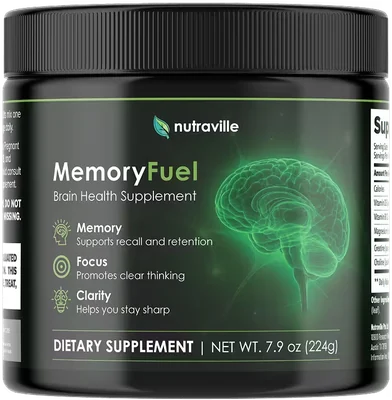
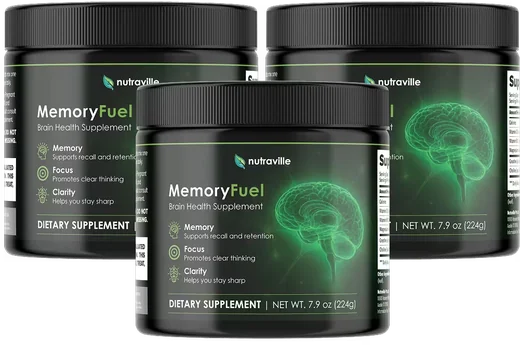
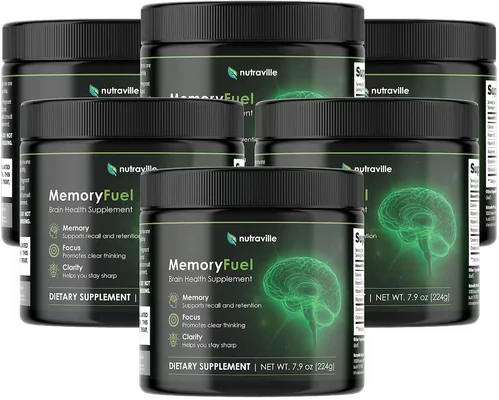
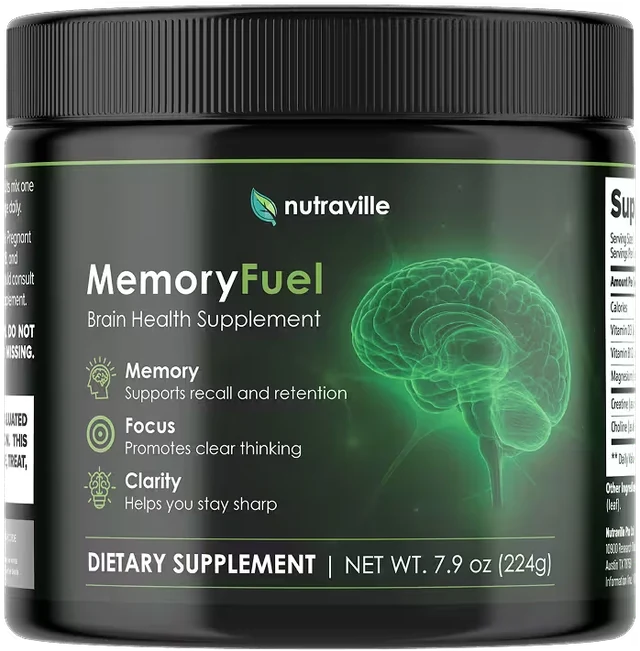
MemoryFuel Brain Health Supplement jar by Nutraville, black with a glowing green brain on the label
Label profileper 1 scoop
Creatine monohydrate5,000 mg
Choline (dl-bitartrate)300 mg · DV n/a
Magnesium, glycinate chelate300 mg · 71% DV
Vitamin D3 · Vitamin B1250 mcg · 25 mcg
Sweetener · EnergyStevia · 1 kcal

Transcribed from the maker's label artwork. L-theanine, caffeine, herbs: none listed.

01 / Spec sheet

MemoryFuel spec sheet: six lines you can verify

Each line below can be checked by any buyer, drawn from the jar label, the maker's order page and its shipping and refund policy, all re-read on October 19, 2026.

Primary role

A once-daily brain health drink mix anchored by creatine, designed as an add-on to sleep, movement and a decent diet, never a substitute.

Serving & form

One level scoop per 6-8 oz glass. A 224 g (7.9 oz) jar divides into 30 servings of roughly 7.5 g, so each jar is a month of MemoryFuel.

Key actives

Creatine monohydrate 5,000 mg, choline 300 mg, magnesium 300 mg, vitamin D3 50 mcg and vitamin B12 25 mcg, every amount printed.

Manufacturing statement

The jar shows a GMP mark and "Made in the USA" from U.S. and imported ingredients, at a plant on the FDA registration list, for Nutraville of Austin, Texas.

Price tiers

$69 for one jar (+$9.99 shipping), $59 a jar on three, $49 a jar on six; the two bigger packs ship free inside the U.S.

Refund window

Ninety days from the order date; empty jars still qualify; shipping and handling are deducted; payment follows about two days after the jars reach Ohio.

02 / The short version

MemoryFuel in 60 seconds

Four answers for the reader in a hurry. They are also the passages search engines and AI assistants most often lift from a page like this, so each one stands on its own.

  1. What it is, and what it is not

    A flavored creatine drink mix fortified with choline, magnesium and the vitamins D3 and B12. Legally a dietary supplement; not a drug, not a dementia or ADHD treatment, and not the L-theanine formula some MemoryFuel adverts describe.

  2. How you take it

    Shake the jar, scoop one level measure into a glass of water or juice, stir until the powder clears and drink it straight away. Same time each day. Nothing to swallow whole, no second dose in the evening.

  3. Who it suits

    Adults with healthy kidneys who want a single daily habit covering creatine and a few memory-relevant nutrients, above all people whose plates are mostly plants, and who accept modest evidence.

  4. What happens if it disappoints

    Write to the maker's helpdesk before day 90 and send the jars, opened or sealed, to the Ohio warehouse; MemoryFuel's price is refunded minus shipping and handling.

03 / The reader's problem

What sends people searching for a creatine memory powder like MemoryFuel

Nobody types "creatine for the brain" into a search bar out of idle curiosity. Something felt different first. These are the four situations that bring most readers here, each with a frank note on how much a powder can do.

Names that arrive a second too late

Reaching for a word or a name and finding it just out of range becomes more common from middle age on, and on its own it is a normal part of aging rather than a sign of disease.[34] What separates ordinary slips from warning signs is pattern and impact: repeating the same question, getting lost on familiar routes or struggling with bills calls for a doctor, not a supplement.[35]

The 2 p.m. fog

An afternoon slump in concentration usually traces back to short sleep, a heavy lunch, dehydration or long stretches without a break. Creatine's clearest cognitive effects appear when the brain is strained, by lost sleep for instance, which helps explain why studies in rested, healthy adults are less convincing.[12][11]

A mostly plant-based diet

Dietary creatine is found mainly in meat and fish, which leaves vegetarians and vegans with smaller body stores. Two of the trials that found memory or reasoning gains were run partly or wholly in vegetarians, which makes this the group most likely to notice a difference.[7][8]

Wanting to protect the brain long term

Many readers are thinking about a parent's diagnosis. The most solid protective factors are not in a jar: blood pressure, hearing, physical activity, social contact, diabetes control and not smoking top the list in the 2024 Lancet Commission report, and a year of brisk walking has even been shown to enlarge the hippocampus.[33][32] A supplement can sit alongside those habits; it cannot replace them.

04 / In formulation terms

MemoryFuel defined: what is actually in the jar

Picture a black 224 g jar of flavored drink-mix powder under the Nutraville brand, with "Brain Health Supplement" printed beneath the name and three promises on the front: memory, focus and clarity. In law MemoryFuel counts as a dietary supplement, so it reached the market without any agency testing whether it works, and the maker is responsible for its safety and for keeping its claims truthful.[41]

From a formulation point of view, it is best described as a creatine monohydrate base with four fortifying nutrients. Creatine accounts for two thirds of every scoop by weight. The remaining actives are nutrients with official reference intakes: magnesium, choline, D3 and B12. There is no proprietary blend, no botanical extract, no caffeine and no stimulant, which is unusual in the memory supplement aisle and makes the product easier to evaluate.

That simplicity cuts both ways. Every ingredient can be checked against published research, and the doses are not hidden. But it also means MemoryFuel stands or falls largely on creatine, a compound sold for decades as a cheap sports powder, whose brain effects in healthy adults are real but small in the better trials.[4][5]

Two things the product is not. It is not a replacement for donepezil, memantine or any prescription treatment, and it should never be used to delay a medical assessment of memory loss. And it is not quite the formula its own advertising describes: the order page names L-theanine as an ingredient, yet the printed panel, the one document with legal weight, leaves it out.

05 / Mechanism

The working theory behind MemoryFuel

The formula is built around energy supply. Neurons spend energy fast and cannot store much of it, and creatine is the body's short-term buffer. Here is the chain of reasoning, step by step, with the honest caveats attached.

01

Creatine and the brain's energy buffer

Inside cells, creatine is phosphorylated to phosphocreatine, a reserve that can hand its phosphate back to ADP and rebuild ATP within seconds. The brain uses this system heavily. Oral creatine monohydrate does reach the brain, but the rise is modest: in a classic spectroscopy study, four weeks at 20 g a day lifted total brain creatine by under a tenth on average, far less than the increase seen in muscle.[1][2] A 5 g daily scoop should move brain levels more slowly still.

02

Choline and acetylcholine

Choline feeds acetylcholine, a messenger chemical for attention and learning, and phosphatidylcholine in cell membranes. Framingham Offspring participants who ate more choline did slightly better on tests of verbal and visual recall, an association rather than proof that supplements help.[21] Most Americans fall short of the adequate intake, so a top-up is defensible on nutritional grounds alone.[22][23]

03

Magnesium and the stress response

Magnesium is a cofactor for hundreds of enzymes, including those that use ATP, and it regulates NMDA receptors in the brain. A systematic review found suggestive but low-quality evidence that magnesium helps subjective anxiety in vulnerable groups.[26] The glycinate form is chosen mainly because it is gentle on the gut compared with oxide or citrate.[25]

04

Vitamins D3 and B12: insurance, not boosters

Both vitamins matter for the nervous system, and both often run low after 60. The catch is that topping up rarely sharpens memory unless levels were low to begin with. In the large VITAL trial, 2,000 IU of vitamin D3 a day, the same amount as one scoop, did not slow cognitive decline.[28] B12 supplements likewise showed no cognitive benefit outside deficiency.[30]

05

Why put them together

The logic of the stack is complementary: creatine for energy buffering, choline for neurotransmitter supply, magnesium for enzyme function, D3 and B12 to close common nutritional gaps. It is a reasonable design. It is also untested as a combination, so any claim of synergy is a hypothesis, and the only component with a direct memory-trial base is creatine.

06 / Ingredient monographs

MemoryFuel ingredients, monograph by monograph

Five actives and three inactive ingredients. Each card pairs what the label says with what the research says, so you can judge the dose rather than the adjective.

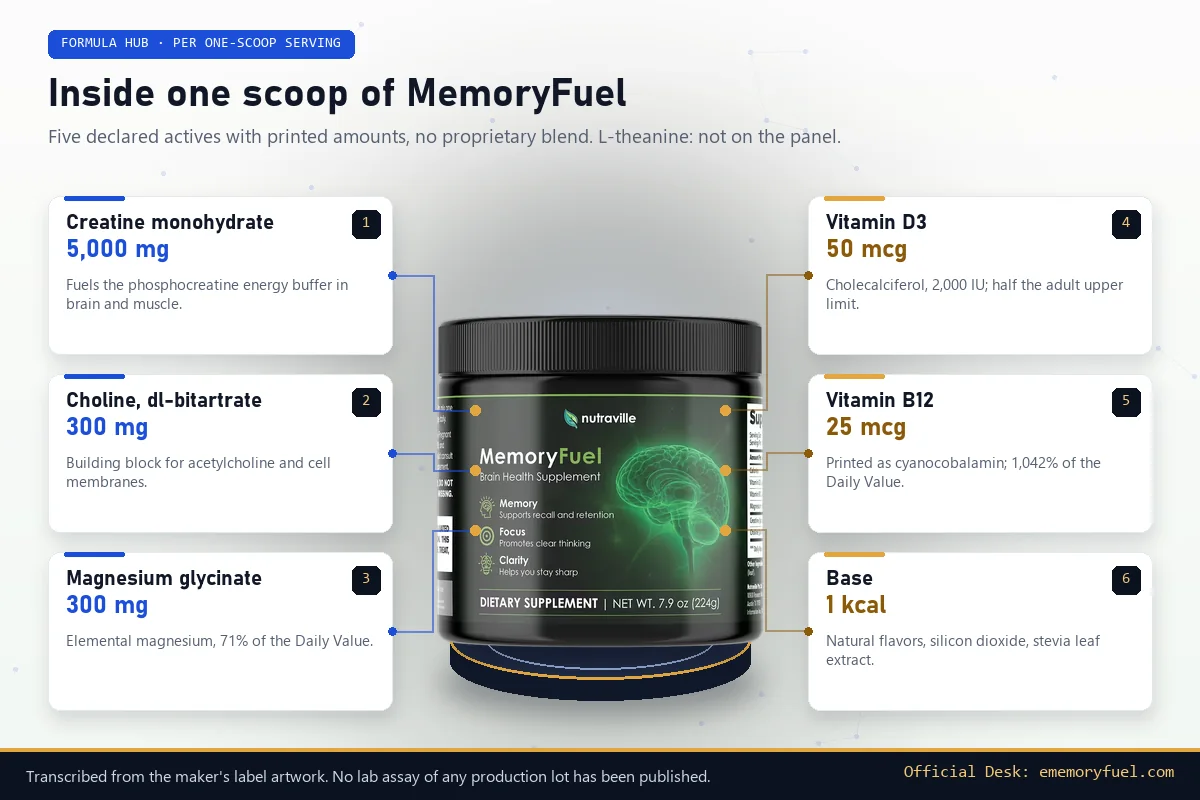
Infographic: MemoryFuel jar at the center of six cards listing creatine 5,000 mg, choline 300 mg, magnesium 300 mg, vitamin D3 50 mcg, vitamin B12 25 mcg and the stevia base
Figure 1: Inside one scoop, transcribed from the maker's label artwork. No independent assay of a production lot has been published.
5,000 mg · monohydrate

Creatine

The anchor ingredient and the reason the scoop is so heavy. Monohydrate is the form used in nearly every published trial, it is stable as a dry powder, and no newer form (ethyl ester, buffered, hydrochloride) has beaten it in head-to-head work.[15] Five grams is the classic daily maintenance amount in sports nutrition.[36]

What creatine studies found

The 2018 Avgerinos review of six randomized trials in healthy people found possible gains in short-term memory and reasoning, with inconsistent results across tasks.[4] A 2023 meta-analysis pooled a small memory benefit that looked larger in adults aged about 66 to 76, and a 2024 analysis of sixteen trials found effects on memory, attention time and processing speed but not on overall cognition.[5][6]

300 mg · dl-choline bitartrate

Choline

Bitartrate is the cheapest and most common choline salt, about 41% choline by weight. The panel marks this line with a double asterisk, meaning no Daily Value, even though FDA rules now set one at 550 mg; that hints the 300 mg may be the salt weight, which would equal roughly 123 mg of choline itself.[40][39]

What choline studies found

Adequate intake is 550 mg a day for men and 425 mg for women, with an upper limit of 3,500 mg.[23] Higher dietary choline tracked with better memory in a large cohort, though no trial has shown a 300 mg bitartrate supplement improving memory in healthy adults.[21] Gut bacteria turn choline into TMAO, which drew attention after a 2016 study linked it to platelet reactivity.[24]

300 mg elemental · glycinate

Magnesium

The 71% Daily Value figure confirms this is elemental magnesium (300 of 420 mg), not the weight of the glycinate compound. Glycinate is a chelate that tends to cause less diarrhea than oxide. Because elemental magnesium is only a fraction of the chelate's weight, this line alone occupies an estimated 1.5 to 2.1 g of each scoop.

What magnesium studies found

The RDA is 400 to 420 mg for men and 310 to 320 mg for women, and the upper limit for magnesium from supplements is 350 mg a day, so one scoop sits just under it.[25] Evidence for memory specifically is thin; the clearest signal is a possible effect on subjective anxiety in people with low magnesium status.[26]

50 mcg · 2,000 IU

Vitamin D3

Cholecalciferol at 250% of the Daily Value. It is a sensible dose for people who get little sun, and a dose to add up if you already take a multivitamin or a separate vitamin D softgel, since 50 mcg is half the adult upper limit of 100 mcg.[27]

What vitamin D3 trials found

Low vitamin D status is associated with poorer cognition in observational studies, but in randomized trials supplementation has disappointed. Two ancillary studies of the VITAL trial gave 2,000 IU daily for two to three years and found no slowing of cognitive decline in older adults.[28]

25 mcg · cyanocobalamin

Vitamin B12

The jar prints cyanocobalamin, the stable, well-studied synthetic form, while the maker's homepage text says methylcobalamin. Both correct a deficiency. At 25 mcg (1,042% DV), only a couple of micrograms are absorbed per dose, which is plenty for most people.[29]

What B12 studies found

A 2021 meta-analysis found B12 supplements did not improve memory, mood or fatigue in people without advanced neurological disease or deficiency.[30] The group that does benefit is easy to name: long-term metformin users, people on acid-suppressing drugs and many adults over 60, whose absorption falls.[31][29]

Other ingredients

Flavor, silica, stevia

Natural flavors set the taste, silicon dioxide keeps the powder flowing instead of caking (permitted as an anticaking agent at up to 2% of a food's weight), and stevia leaf extract sweetens without sugar, which is why a serving carries just one calorie.[38][37]

Base: what it means for you

No sugar, no artificial colors listed, no common allergens declared on the panel. Stevia leaves a faint licorice note that bothers some drinkers; orange juice or a smoothie covers it well. Because silica is present, a fine haze can remain in the glass after stirring, which is normal.

07 / Dose audit

Scoop dose against study dose: the honest arithmetic

MemoryFuel's creatine amount is a genuine research dose, but the blend itself is untested

Most memory supplements fail a dose audit at the first line, because their key herbs hide inside a blend. MemoryFuel does not. Five grams of creatine monohydrate a day is a genuine research amount: muscle studies show that 3 g a day eventually fills stores as completely as a 20 g loading week, just more slowly, taking around four weeks instead of six days.[13][14] One trial that found working-memory and reasoning gains in vegetarians used exactly 5 g a day for six weeks.[7]

The complication is the brain. Brain creatine responds less than muscle, and several of the positive cognitive trials used much more: 20 g a day for a week in older adults, 20 g a day for five days in the vegetarian-and-omnivore study, and a single dose of about 0.35 g per kilogram (roughly 25 g for an average adult) in the 2024 sleep-deprivation experiment the adverts call a "Nature study". That paper appeared in Scientific Reports, a Nature-portfolio journal, and it tested sleep-deprived volunteers, not people taking a daily maintenance scoop.[9][8][11] At a maintenance-style dose, rested young adults showed no cognitive gain whatsoever.[10]

For the supporting nutrients the picture is simpler: they are nutritional doses, not pharmacological ones. Magnesium and vitamin D3 are at sensible levels that respect upper limits; B12 is generous; choline is modest and possibly lower than it looks. None of the four has good evidence of improving memory when levels are already adequate. Put plainly, MemoryFuel is a properly dosed creatine product with useful nutritional insurance, sold with stronger language than its evidence supports.

Your weight vs. the research doses

Creatine research is often dosed per kilogram. Enter your weight to see where one 5 g scoop lands.

Scoop per kg-
Maintenance (0.03 g/kg)-
Loading day (0.3 g/kg)-
2024 single dose-

Enter your body weight to see how one 5 g scoop compares with the doses used in creatine research.

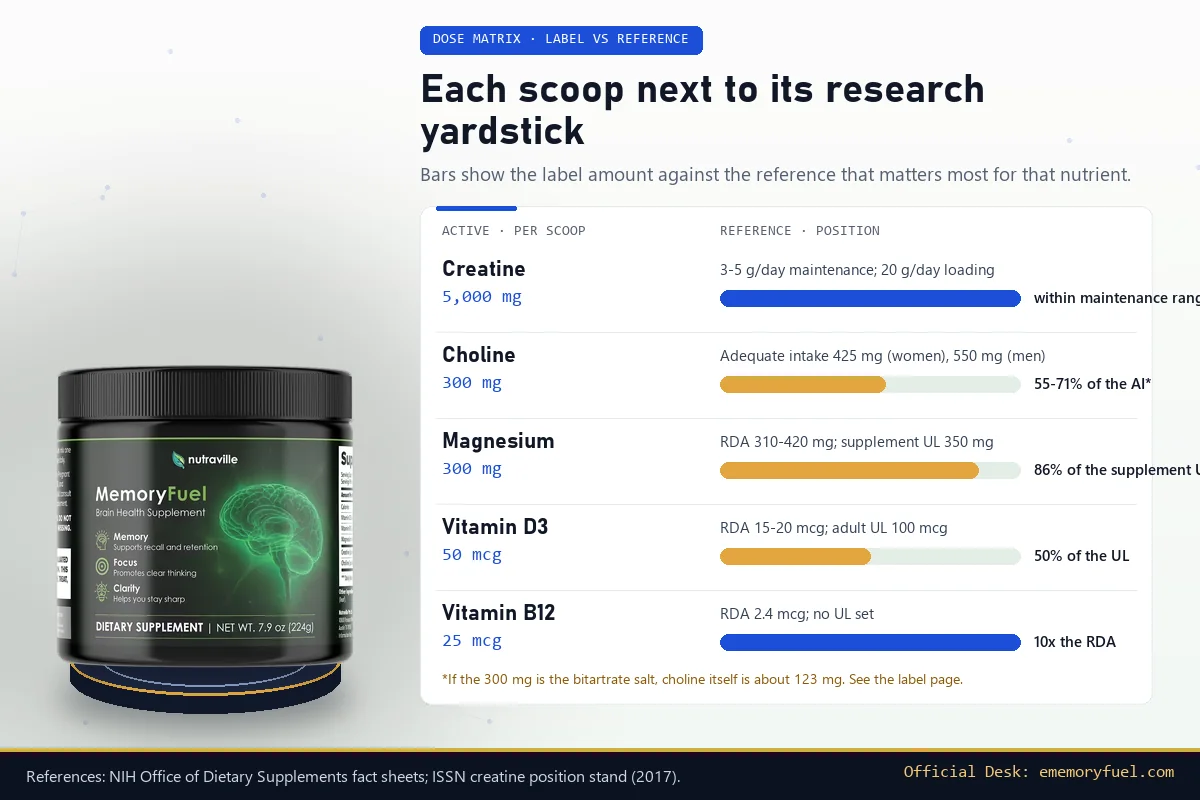
Dose matrix comparing each MemoryFuel ingredient with its reference: creatine within the maintenance range, choline below the adequate intake, magnesium near the supplement upper limit, D3 at half the upper limit, B12 ten times the RDA
Figure 2: Each scoop against its yardstick. References: NIH Office of Dietary Supplements fact sheets and the ISSN creatine position stand.
08 / Panel and fine print

The MemoryFuel label, transcribed and read closely

The Supplement Facts panel as the brand's own label art prints it, then the directions, caution text and maker block in plain English.

Supplement Facts
Serving Size: 1 Scoop · Servings Per Container: 30
Amount Per Serving%DV
Calories1
Vitamin D3 (as cholecalciferol)50 mcg250%
Vitamin B12 (as cyanocobalamin)25 mcg1042%
Magnesium (as magnesium glycinate)300 mg71%
Creatine (as creatine monohydrate)5,000 mg**
Choline (as dl-choline bitartrate)300 mg**

Footnote on the jar: ** means no Daily Value. Inactive ingredients: stevia leaf extract, silicon dioxide and natural flavors. Net weight 224 g (7.9 oz). Maker: Nutraville, Austin, Texas; information line 1-302-251-2961.

Directions and cautions, in plain English

Use: one scoop a day for adults, stirred into a 6-8 oz glass of water or any drink you like.

Cautions: stay at the stated dose; anyone pregnant, breastfeeding, under 18 or living with a diagnosed condition should talk to a physician first; store the jar cool, dry and out of children's reach; and reject it if the seal is broken or absent. The full wording is on our Supplement Facts page.

Three things the panel tells a careful reader. First, every amount is printed, so you are never guessing. Second, the B12 form is cyanocobalamin, not the methylcobalamin the homepage mentions. Third, the double asterisk on choline is odd because FDA rules give choline a Daily Value of 550 mg; a 300 mg choline line should read 55%.[40]

What a certificate of analysis would show

A certificate of analysis (CoA) is a lab report for one production lot. For this powder it would normally list:

  • Assay of creatine, magnesium, D3 and B12 against the label claim
  • Heavy metals (lead, arsenic, cadmium, mercury)
  • Microbial counts, yeast and mold
  • Creatinine and dicyandiamide, the impurities that matter for creatine

Nutraville has not published a CoA for any MemoryFuel lot, and this desk has not tested one, so we show no numbers. You can ask for your lot's CoA at support@thememoryfuel.com; the jar's lot and date code identify it. Manufacturing rules under 21 CFR Part 111 require the maker to verify identity, purity and strength before release.[42]

09 / Realistic expectations

Realistic MemoryFuel benefits, worded as narrowly as the evidence

Four benefits we can stand behind, each phrased as narrowly as the evidence allows. The asterisk is the legal reminder that none of these statements has been evaluated by the FDA.

Creatine at a research-grade daily dose

Five grams of monohydrate a day reliably raises body creatine stores within about a month, and the brain modestly. In healthy adults that has translated into small memory gains in some trials, more clearly in older people and vegetarians.

Nutritional cover for common gaps

Vitamin D, B12, magnesium and choline all run short in many American diets, more so after 60 and for people taking metformin or acid blockers. One scoop covers or narrows each gap without megadoses.

A transparent, stimulant-free formula

No caffeine, no proprietary blend and no herbal extracts with unpredictable potency. If you react to something, you can identify it, and you can discuss the full list with your doctor in thirty seconds.

A habit that is easy to keep

One drink a day replaces three or four separate pills, which matters because creatine only works when taken consistently. The 90-day refund term also gives a full saturation period before you have to decide.

Limits worth stating plainly

  • No effect on dementia, Alzheimer's disease or mild cognitive impairment can be claimed or expected.
  • It does not work "within hours" at one scoop; the short-term effect seen in research used about five times this dose under sleep deprivation.
  • It does not contain L-theanine, whatever the order page lists.
  • No powder substitutes for a medical workup of memory loss, low B12 or low vitamin D.
  • Short sleep erodes memory consolidation faster than any scoop could rebuild it.
10 / Strengths and weaknesses

Where MemoryFuel earns points, and where it loses them

MemoryFuel pros

  • Every amount printed; no proprietary blend
  • Creatine monohydrate at the 5 g research dose
  • Magnesium and D3 kept below their upper limits
  • No caffeine, sugar or artificial sweeteners listed
  • One drink replaces several capsules
  • Long 90-day refund window that accepts empty jars
  • Free U.S. shipping on three and six jars

MemoryFuel cons

  • Costs many times more than plain creatine plus a multivitamin
  • Adverts list L-theanine that the label does not
  • Choline line is ambiguous and may deliver only ~123 mg
  • Refund excludes shipping and handling, and you pay return postage
  • No toll-free number published despite the policy mentioning one
  • Can raise creatinine on blood tests and cause early water weight
  • Sold only online, through ClickBank
11 / Fit check

A 30-second fit test before you buy MemoryFuel

Likely a reasonable fitPause and ask a clinician first
Adult with normal kidney functionKidney disease, one kidney, or diabetes affecting the kidneys
Mostly plant-based diet, or past 60Pregnancy, breastfeeding or age under 18, per the label
You want creatine without swallowing pillsYou already take creatine, a vitamin D supplement or a magnesium product
You can commit to one scoop daily for 8 to 12 weeksYou take tetracyclines, quinolones, bisphosphonates or thiazide diuretics
You accept modest, gradual effectsYour memory has worsened noticeably over months: see a doctor first
You prefer a stimulant-free productYou want the cheapest possible creatine: buy plain monohydrate instead

If two or more lines in the right-hand column describe you, the sensible order is conversation first, purchase second. A pharmacist can check the label against your medicine list in a few minutes, and a primary care doctor can order the B12 and vitamin D tests that tell you whether those parts of the scoop are doing anything for you at all. Federal health agencies give the same advice for any supplement: tell every clinician what you take.[45]

12 / Mixing protocol

The MemoryFuel mixing protocol in four steps

The label direction is one line long. This is the same direction broken into the four steps that make the powder dissolve properly and the creatine arrive intact.

  1. 1

    Shake the jar, then level the scoop

    Fine particles separate during shipping. Turning the closed jar over a few times remixes the vitamins, and scraping the scoop flat on the rim keeps every serving near its intended 7.5 g.

  2. 2

    Pour a 6-8 oz glass first

    Plain water is fine; juice or a smoothie hides the stevia. Room-temperature liquid dissolves creatine faster than ice water. Avoid very hot drinks.

  3. 3

    Stir 20 seconds and drink it now

    Creatine slowly converts to creatinine once dissolved, faster in warm or acidic liquid, so do not mix tomorrow's serving tonight.[15] A faint haze from the silica is normal.

  4. 4

    Check your medicines first

    Because of the magnesium, keep a few hours between the scoop and antibiotics or osteoporosis tablets, and talk to a doctor first with any kidney condition or a long prescription list.

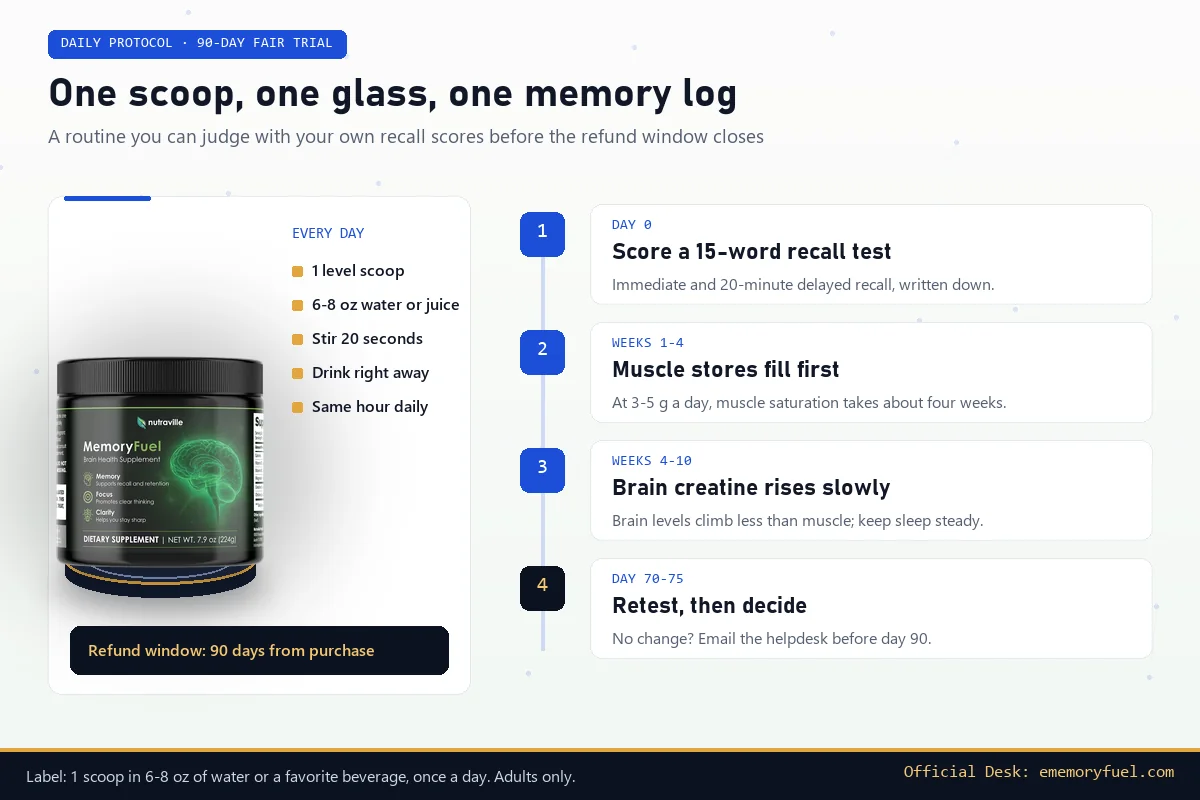
Daily protocol: one scoop in 6 to 8 oz of liquid, stirred and drunk right away, plus a four-step timeline from a day-0 recall test to a day 70 to 75 retest before the 90-day refund deadline
Figure 3: The daily protocol and a 90-day evaluation plan built around your own recall scores.
13 / Format

Why MemoryFuel comes as a scoop, not a capsule or gummy

The powder format is not a style choice. It is forced by the dose. Five grams of creatine plus around two grams of magnesium glycinate would need six to eight large capsules a day, and gummies can carry only a gram or so of creatine each while adding sugar and gelatin. Only a scoop can carry this formula in a single daily serving.

Absorption is not the deciding factor: the gut takes up nearly all creatine monohydrate whatever form it arrives in. The real differences are practical. Powder lets you split a dose if your stomach is sensitive, mixes into food and drinks, and avoids capsule shells. It also has drawbacks: you have to measure it, the scoop can be heaped or scant, it can clump if moisture gets in, and travel is clumsier.

FormatCreatine per unitUnits for 5 gTrade-off
MemoryFuel powder5 g per scoop1 scoopMust be measured and mixed; tastes of stevia
Creatine capsulesabout 0.75 g6 to 7No taste, but many pills
Creatine gummiesabout 1 g5Sugar and pectin or gelatin; potency complaints are common in the category
Ready-to-drink liquidsvaries-Dissolved creatine slowly degrades on the shelf

Storage is where powder needs care. Keep the lid tight, keep the scoop dry, and store the jar away from the shower and the stove; humidity is what makes creatine powders cake. Hard lumps can be broken with a dry spoon and are not a sign of spoilage, but a jar that smells sour or has turned yellow should go back.

14 / Ordering

Four steps from this page to a MemoryFuel delivery

The checkout belongs to the maker and runs on ClickBank, which acts as retailer. This desk only explains the route and passes you along.

  1. 1

    Choose a pack

    One jar to test the taste, three for a full creatine saturation period, six for the lowest price per scoop. All three are one-time charges.

  2. 2

    Check out on ClickBank

    The order button opens the maker's ClickBank payment page. Card details go to ClickBank, never to this site.

  3. 3

    Watch for two emails

    A ClickBank receipt carrying your order number arrives at once; a tracking email normally follows within a day once the warehouse confirms the order.

  4. 4

    Keep the order number

    Refunds and delivery questions start with that number. Note the date too: the 90 days run from purchase, not delivery.

FulfillmentJetpack, a third-party fulfillment company, packs MemoryFuel orders in Tallmadge, Ohio, according to the shipping policy.
TimingOrders are prepped in 3 to 5 business days, tracking is emailed within 24 hours of confirmation, and delivery takes 5 to 7 business days.
CarriersUSPS and UPS. Orders abroad are accepted; expect 12 to 18 business days and a shipping charge.
FreshnessNo manufacturing date is promised. Check the lot and best-by code on the jar when it arrives; creatine powder is stable for years when kept dry.
Storage on arrivalCool, dry cupboard, lid tight. The label asks for exactly that, and humidity is the main threat to a powder.
Order helpPayment questions go to ClickBank's order support; product questions to support@thememoryfuel.com.
15 / Price cards

MemoryFuel prices: three packs, one-time charges

Prices as listed on the official order page on October 19, 2026. The crossed-out "regular" prices are the seller's reference figures; nobody we know of pays them, and federal pricing guides treat such comparisons with suspicion.[44]

1 jar

30-day supply · trial size

One MemoryFuel jar
$69 /jar

$99 · total $69 + $9.99 shipping

  • $2.63 a day with shipping
  • Good for testing taste and tolerance
  • Too short for full creatine saturation plus evaluation
Order 1 jar

3 jars

Three months · fits the refund window

Three MemoryFuel jars
$59 /jar

$297 · total $177, free U.S. shipping

  • Works out to $1.97 daily
  • Covers saturation plus a fair test
  • Unopened jars still count for the refund
Order 3 jars
Lowest per scoop

6 jars

Six months · two digital bonuses

Six MemoryFuel jars
$49 /jar

$594 · total $294, free shipping

  • $1.63 a day
  • Includes an audio series and a nutrition guide (digital)
  • Largest outlay if the powder does not suit you
Get 6 jars at $49 each
16 / Unit economics

Cost per scoop, per day and per gram of creatine

Per day is the honest unit for a once-daily product, because each jar is exactly 30 scoops. With shipping included, the single jar costs $2.63 a day, the three-jar pack $1.97 and the six-jar pack $1.63. The six-pack saves $1.00 a day over the single jar, or $180 across six months, compared with buying single jars one at a time.

The formulation desk also tracks a second unit: what you pay per 100 g of creatine, since creatine is two thirds of the powder. That works out to about $52.66 on one jar, $39.33 on three and $32.67 on six. Plain creatine monohydrate at retail usually costs well under fifty cents per 5 g serving, and vitamin D3, B12 and magnesium glycinate are cheap too. In other words, most of the price is paying for the combination, the flavoring, the brand and the 90-day refund, not for the raw materials.

Which pack is best value depends on one thing: whether you will still be taking it in month four. Creatine needs about four weeks to saturate muscle and longer for any brain effect to show, so the single jar is too short to judge memory. The three-jar pack lines up exactly with the refund window and is, for most first-time buyers, the rational choice. Six jars only make sense once you know you like it.

Scoop and spend planner

Total paid-
Per day-
Per 100 g creatine-
Supply-
Per jar-
Retest by-
Refund deadline-
Runs out about-

"Runs out" allows roughly a week for processing and transit. The refund date is simply the order date plus 90 days, per the written policy.

17 / Safety bench

MemoryFuel safety: tolerance, lab numbers and drug spacing

Creatine is one of the most studied supplements in existence, and the other four actives are ordinary nutrients at ordinary doses. The safety story is therefore mostly about who should check first and which lab numbers can shift.

Creatine in healthy adults

The International Society of Sports Nutrition reviewed short and long-term data and judged creatine monohydrate safe for healthy people at doses well above 5 g a day.[16] Common worries, including dehydration, cramps and hair loss, have weak or no support in controlled studies; the hair worry traces back to one small rugby study that measured a hormone, never hair.[17][20] Early weight gain of a pound or two is mostly water drawn into muscle.

Kidneys and the creatinine number

Long-term use did not impair kidney function in healthy athletes.[18] But creatine's breakdown product, creatinine, is also the yardstick for kidney filtration, so a daily user can look worse on paper with perfectly healthy kidneys; published cases describe exactly that.[19] People with existing kidney disease should not start without their nephrologist.

Magnesium: timing and the gut

300 mg is under the 350 mg supplemental upper limit, but adding another magnesium product can pass it and cause loose stools. Magnesium latches onto tetracycline and quinolone antibiotics and bisphosphonates in the gut, so keep a few hours between them.[25]

Vitamins D3 and B12

2,000 IU of D3 is safe for most adults but adds to other sources; with thiazide diuretics, high calcium is a theoretical concern.[27] B12 has no known toxicity at this dose, and metformin users often need it.[31]

Check with a clinician first when you...

  • live with kidney disease, take NSAIDs every day or use other kidney-stressing drugs
  • are pregnant, breastfeeding or under 18 (the label's own exclusion)
  • have bipolar disorder: a few case reports have linked creatine to manic episodes in susceptible people
  • take several prescriptions, so a pharmacist can space the magnesium correctly
  • are scheduled for blood work, so the creatinine result can be read in context

Choline at gram doses can cause a fishy body odor and low blood pressure; one scoop is far below that range.[23]

18 / Saturation timeline

The MemoryFuel saturation clock: weeks, not hours

The honest timeline follows creatine kinetics, not marketing copy. At 5 g a day without a loading phase, body stores fill gradually over about a month, and the brain lags behind muscle.

Days 1 to 14

Build the habit

Same time, same glass. Watch your stomach and the scale; a small water gain is expected. Take your baseline recall test before the first scoop.

Days 15 to 30

Muscle stores fill

Muscle stores near their ceiling around week four on a 3-5 g daily intake.[13] Notice energy in workouts and stairs first, if anything.

Days 31 to 70

The brain window

Positive memory trials ran from one to six weeks, mostly at higher doses. This is the stretch where any cognitive effect from 5 g a day should appear.[7][5]

Days 70 to 90

Retest, then decide

Repeat the recall test with a fresh word list. No change and no felt benefit? Email the helpdesk before day 90, since the window counts from purchase.

Recall log: a simple before-and-after test

Use a different list of 15 unrelated words each time. Read it for one minute, write down what you recall immediately and again after 20 minutes.

Read a fresh list of 15 unrelated words for one minute, write down what you remember right away and again 20 minutes later. Do it on day 0 and again around day 70, using a different list each time.

19 / Refund route

The MemoryFuel 90-day refund: route and fine print

It does have one: a 90-day window counted from the day you buy, empty jars included, with shipping and handling deducted. Below is the route the policy pages lay out, with the gaps marked.

  1. The clock starts at checkout

    The policy counts 90 days "from your original purchase," so a jar delivered on day 10 still has 80 days left, not 90.

  2. Give it at least 60 days of daily use

    Creatine needs weeks to build up. Judging after one jar mostly measures taste, not effect.

  3. Decide by day 75

    That leaves two weeks for emails, packing and transit before the window closes.

  4. Contact the helpdesk

    Write to support@thememoryfuel.com quoting the order number, or file the request with ClickBank's order support. The policy mentions a toll-free number, but none is published on the maker's site; the 1-302-251-2961 line on the jar is labeled as an information line.

  5. Mail the jars to Ohio

    Every jar goes back, whether sealed, half used or empty, to the Jetpack warehouse that shipped it (address on our guarantee page). Use tracking and keep the receipt.

  6. You pay return postage, and S&H is kept

    The policy deducts shipping and handling, and the cost of mailing the jars back falls to you. On a one-jar order that means the $9.99 shipping is not returned.

  7. Wait for the credit

    The policy says money goes back within two days of the jars arriving; your card issuer may take several more business days to show it.

Why people send MemoryFuel back

They expected a fast effect

The order page talks about improvements within hours. At 5 g a day, that expectation sets people up to be disappointed in week one.

Taste and texture

Stevia sweetness and a slightly gritty glass are a dealbreaker for some. Juice or a smoothie usually fixes it.

A doctor said no

Kidney concerns, a medication clash or an upcoming lab test can end a trial early. That is the system working as it should.

The maker publishes no refund statistics and neither do we; the reasons above are the ones that follow from the product and its marketing.

20 / Verdict on legitimacy

Real product or scam? A legitimacy verdict on MemoryFuel

On everything we can check, MemoryFuel is a genuine product, not a scam that takes money and ships nothing. The jar prints a complete, specific panel, an identifiable company with an Austin address and a phone line, a GMP mark, a real fulfillment partner in Ohio and a checkout run by ClickBank, which acts as retailer of record and handles refunds independently of the vendor.

Where it earns criticism is the marketing. The order page lists L-theanine, which the label does not include. It cites a "2024 Nature study" that was actually published in Scientific Reports and used about five times a scoop's creatine in sleep-deprived volunteers.[11] It runs a comparison table implying a Cleveland Clinic endorsement, yet the Clinic's own site says it does not endorse non-Clinic products. Its homepage references list studies on prostate health, iodine and shilajit, apparently carried over from a different product. Two pages give two different review counts.

None of that makes the powder dangerous or fake. It does mean the sales copy should be read as advertising, not science, and that the jar in your hand is the document to trust. Legit is not the same as miraculous: expect a well-made creatine drink with modest, gradual effects, and use the 90-day window if it does not earn its place.

21 / Channel

Where MemoryFuel is actually sold

MemoryFuel is sold through the maker's own sales pages with payment processed by ClickBank. We found no authorized listing on Amazon, Walmart, eBay or in pharmacies in October 2026. The refund policy described above applies only to orders placed through that checkout, because it is ClickBank that records the purchase and the vendor that honors the return.

Name check and lookalike listings

Search results also show unrelated "memory fuel" products, other creatine gummies and pages selling "MemoryFuel" through unfamiliar storefronts. A marketplace jar may be genuine, resold or old stock; without a ClickBank order number, the 90-day promise does not follow it. If you do buy elsewhere, check the jar against the inspection list on our jar inspection page: Nutraville logo, 7.9 oz (224 g), the cyanocobalamin line and an intact inner seal.

Each MemoryFuel order button here routes through a short redirect to the maker's checkout and carries a tracking tag that tells the vendor this desk referred you. That is how the commission that funds this site is paid; it does not change your price.

22 / Feedback audit

MemoryFuel reviews: what the feedback actually contains

Most "reviews" in search results are affiliate pages or the maker's own testimonials. Rather than invent a rating, this desk sorts what can be learned into themes and labels where each theme comes from.

Seller testimonials

Dramatic recall stories, unverifiable

The order page features retirees describing remembered names and finished journals within weeks, with "Verified Purchase" tags. The maker's disclaimer page concedes testimonials may be edited and that results vary. Under FTC rules such stories should reflect typical results, which a supplement trial would never promise.[43]

Creatine users in general

Gradual, subtle changes

Across the wider creatine literature, people who notice anything describe steadier energy during long days or poor sleep, not a sudden jump in memory. That matches the trial data.[3]

Product format

Taste and mixing comments

Stevia-sweetened creatine drinks attract predictable remarks: pleasant enough for some, a bitter finish for others, grit when stirred briefly. Warm-ish water and longer stirring help.

Policy pages

Where friction could arise

Shipping and handling are not refunded, return postage is the buyer's, and the toll-free number the policy mentions is not published. Those are the points to clarify before you order.

Complaints we expect MemoryFuel to draw

  • "Week one did nothing": normal on 5 g daily, because brain creatine accumulates slowly.
  • "It is just expensive creatine": partly fair; the formula adds four nutrients, but the price premium is large.
  • "The ingredients are not what the ad said": the L-theanine and methylcobalamin wording on sales pages does not match the jar.
  • "My blood test flagged my kidneys": often a creatinine artifact; tell your doctor you take creatine.
  • "Delivery took over a week": processing (3 to 5 business days) plus transit (5 to 7) can approach two weeks.
23 / Desk score

The desk's MemoryFuel score, criterion by criterion

Six criteria weighted equally, scored against the label and policy pages rather than against user ratings. The score is 6.3 out of 10.

6.3out of 10
Dose fidelity to research
8.5
Label disclosure
8.5
Formulation and stability
8.0
Refund terms
6.5
Cost per active gram
4.0
Marketing accuracy
2.5

The people and process behind this MemoryFuel guide

The MemoryFuel Powder Desk is a small independent editorial team that covers supplement formulations: one writer who drafts each page from the label and policy documents, and a second reader who checks every number against the jar artwork and every claim against its linked source before publication. We do not name a credentialed medical reviewer because we do not have one on staff, and we would rather say so than borrow a title. Our full method is on the editorial standards page and our roles on the editorial board page.

What the score is not

It is not a measure of whether MemoryFuel will improve your memory; no score can predict that. It rates how well the product and its seller hold up to scrutiny: honest doses, clear label, sound chemistry, fair price and truthful advertising. High marks on the first three are dragged down by price and by advertising that promises more than the jar contains.

24 / Search desk

MemoryFuel questions that dominate search

Six questions that show up again and again in search suggestions, each answered in two or three sentences.

Is this the MemoryFuel Supplement official site?

This is an independent guide built around the search for the MemoryFuel Supplement official site. Every order button here leads to the maker's own ClickBank checkout, the only place the 90-day refund applies. We are not Nutraville, and we earn a commission on orders.

Can I find genuine MemoryFuel reviews?

Very few independent ones. The maker's pages show testimonials with "Verified Purchase" tags and two different review counts (3,247 on the order page, 19,651 on the homepage). Neither figure can be checked, so this desk does not average them into a star rating.

Is MemoryFuel just creatine?

Mostly, by weight. Five of the roughly 7.5 grams in a scoop are creatine monohydrate. The rest is magnesium glycinate, choline bitartrate, two vitamins, flavor, an anticaking agent and stevia. Plain creatine costs far less; the premium buys the blend, the flavor and the refund term.

Does MemoryFuel work in a few hours?

Unlikely at this dose. A 2024 study saw short-term effects after one dose of about 0.35 g per kilogram in sleep-deprived volunteers, near 25 g at 70 kg. A single 5 g scoop raises brain creatine gradually, across weeks.

Memory Fuel or MemoryFuel: is it the same product?

Yes, people type it both ways. The jar spells it as one word, MemoryFuel, under the Nutraville logo, with "Brain Health Supplement" beneath. Other creatine or nootropic products with similar names are unrelated and are not covered by this refund policy.

Can creatine raise kidney test results?

Yes, and it is usually harmless. Creatine turns into creatinine, the very molecule kidney panels measure, so regular users can post a higher reading with healthy kidneys. Tell your clinician you take it before blood work.

References

Forty-five sources: randomized trials and reviews on PubMed, NIH fact sheets and federal regulations. Most studies gave creatine or a single nutrient on its own, often at different doses; none tested MemoryFuel as sold.

  1. 1Dechent P, Pouwels PJ, Wilken B, Hanefeld F, Frahm J. Increase of total creatine in human brain after oral supplementation of creatine-monohydrate. Am J Physiol. 1999;277(3):R698-R704. pubmed.ncbi.nlm.nih.gov/10484486/
  2. 2Dolan E, Gualano B, Rawson ES. Beyond muscle: the effects of creatine supplementation on brain creatine, cognitive processing, and traumatic brain injury. Eur J Sport Sci. 2019;19(1):1-14. pubmed.ncbi.nlm.nih.gov/30086660/
  3. 3Roschel H, Gualano B, Ostojic SM, Rawson ES. Creatine supplementation and brain health. Nutrients. 2021;13(2):586. pubmed.ncbi.nlm.nih.gov/33578876/
  4. 4Avgerinos KI, Spyrou N, Bougioukas KI, Kapogiannis D. Effects of creatine supplementation on cognitive function of healthy individuals: a systematic review of randomized controlled trials. Exp Gerontol. 2018;108:166-173. pubmed.ncbi.nlm.nih.gov/29704637/
  5. 5Prokopidis K, Giannos P, Triantafyllidis KK, et al. Effects of creatine supplementation on memory in healthy individuals: a systematic review and meta-analysis of randomized controlled trials. Nutr Rev. 2023;81(4):416-427. pubmed.ncbi.nlm.nih.gov/35984306/
  6. 6Xu C, Bi S, Zhang W, Luo L. The effects of creatine supplementation on cognitive function in adults: a systematic review and meta-analysis. Front Nutr. 2024;11:1424972. pubmed.ncbi.nlm.nih.gov/39070254/
  7. 7Rae C, Digney AL, McEwan SR, Bates TC. Oral creatine monohydrate supplementation improves brain performance: a double-blind, placebo-controlled, cross-over trial. Proc Biol Sci. 2003;270(1529):2147-2150. pubmed.ncbi.nlm.nih.gov/14561278/
  8. 8Benton D, Donohoe R. The influence of creatine supplementation on the cognitive functioning of vegetarians and omnivores. Br J Nutr. 2011;105(7):1100-1105. pubmed.ncbi.nlm.nih.gov/21118604/
  9. 9McMorris T, Mielcarz G, Harris RC, Swain JP, Howard A. Creatine supplementation and cognitive performance in elderly individuals. Neuropsychol Dev Cogn B Aging Neuropsychol Cogn. 2007;14(5):517-528. pubmed.ncbi.nlm.nih.gov/17828627/
  10. 10Rawson ES, Lieberman HR, Walsh TM, Zuber SM, Harhart JM, Matthews TC. Creatine supplementation does not improve cognitive function in young adults. Physiol Behav. 2008;95(1-2):130-134. pubmed.ncbi.nlm.nih.gov/18579168/
  11. 11Gordji-Nejad A, Matusch A, Kleedörfer S, et al. Single dose creatine improves cognitive performance and induces changes in cerebral high energy phosphates during sleep deprivation. Sci Rep. 2024;14(1):4937. pubmed.ncbi.nlm.nih.gov/38418482/
  12. 12McMorris T, Harris RC, Swain J, et al. Effect of creatine supplementation and sleep deprivation, with mild exercise, on cognitive and psychomotor performance, mood state, and plasma concentrations of catecholamines and cortisol. Psychopharmacology (Berl). 2006;185(1):93-103. pubmed.ncbi.nlm.nih.gov/16416332/
  13. 13Hultman E, Söderlund K, Timmons JA, Cederblad G, Greenhaff PL. Muscle creatine loading in men. J Appl Physiol. 1996;81(1):232-237. pubmed.ncbi.nlm.nih.gov/8828669/
  14. 14Harris RC, Söderlund K, Hultman E. Elevation of creatine in resting and exercised muscle of normal subjects by creatine supplementation. Clin Sci (Lond). 1992;83(3):367-374. pubmed.ncbi.nlm.nih.gov/1327657/
  15. 15Jäger R, Purpura M, Shao A, Inoue T, Kreider RB. Analysis of the efficacy, safety, and regulatory status of novel forms of creatine. Amino Acids. 2011;40(5):1369-1383. pubmed.ncbi.nlm.nih.gov/21424716/
  16. 16Kreider RB, Kalman DS, Antonio J, et al. International Society of Sports Nutrition position stand: safety and efficacy of creatine supplementation in exercise, sport, and medicine. J Int Soc Sports Nutr. 2017;14:18. pubmed.ncbi.nlm.nih.gov/28615996/
  17. 17Antonio J, Candow DG, Forbes SC, et al. Common questions and misconceptions about creatine supplementation: what does the scientific evidence really show? J Int Soc Sports Nutr. 2021;18(1):13. pubmed.ncbi.nlm.nih.gov/33557850/
  18. 18Poortmans JR, Francaux M. Long-term oral creatine supplementation does not impair renal function in healthy athletes. Med Sci Sports Exerc. 1999;31(8):1108-1110. pubmed.ncbi.nlm.nih.gov/10449011/
  19. 19Williamson L, New D. How the use of creatine supplements can elevate serum creatinine in the absence of underlying kidney pathology. BMJ Case Rep. 2014;2014:bcr2014204754. pubmed.ncbi.nlm.nih.gov/25239988/
  20. 20van der Merwe J, Brooks NE, Myburgh KH. Three weeks of creatine monohydrate supplementation affects dihydrotestosterone to testosterone ratio in college-aged rugby players. Clin J Sport Med. 2009;19(5):399-404. pubmed.ncbi.nlm.nih.gov/19741313/
  21. 21Poly C, Massaro JM, Seshadri S, et al. The relation of dietary choline to cognitive performance and white-matter hyperintensity in the Framingham Offspring Cohort. Am J Clin Nutr. 2011;94(6):1584-1591. pubmed.ncbi.nlm.nih.gov/22071706/
  22. 22Wallace TC, Blusztajn JK, Caudill MA, et al. Choline: the underconsumed and underappreciated essential nutrient. Nutr Today. 2018;53(6):240-253. pubmed.ncbi.nlm.nih.gov/30853718/
  23. 23NIH Office of Dietary Supplements. Choline: Fact Sheet for Health Professionals. ods.od.nih.gov/factsheets/Choline-HealthProfessional/
  24. 24Zhu W, Gregory JC, Org E, et al. Gut microbial metabolite TMAO enhances platelet hyperreactivity and thrombosis risk. Cell. 2016;165(1):111-124. pubmed.ncbi.nlm.nih.gov/26972052/
  25. 25NIH Office of Dietary Supplements. Magnesium: Fact Sheet for Health Professionals. ods.od.nih.gov/factsheets/Magnesium-HealthProfessional/
  26. 26Boyle NB, Lawton C, Dye L. The effects of magnesium supplementation on subjective anxiety and stress: a systematic review. Nutrients. 2017;9(5):429. pubmed.ncbi.nlm.nih.gov/28445426/
  27. 27NIH Office of Dietary Supplements. Vitamin D: Fact Sheet for Health Professionals. ods.od.nih.gov/factsheets/VitaminD-HealthProfessional/
  28. 28Kang JH, Vyas CM, Okereke OI, et al. Effect of vitamin D on cognitive decline: results from two ancillary studies of the VITAL randomized trial. Sci Rep. 2021;11(1):23253. pubmed.ncbi.nlm.nih.gov/34853363/
  29. 29NIH Office of Dietary Supplements. Vitamin B12: Fact Sheet for Health Professionals. ods.od.nih.gov/factsheets/VitaminB12-HealthProfessional/
  30. 30Markun S, Gravestock I, Jäger L, Rosemann T, Pichierri G, Burgstaller JM. Effects of vitamin B12 supplementation on cognitive function, depressive symptoms, and fatigue: a systematic review, meta-analysis, and meta-regression. Nutrients. 2021;13(3):923. pubmed.ncbi.nlm.nih.gov/33809274/
  31. 31Aroda VR, Edelstein SL, Goldberg RB, et al. Long-term metformin use and vitamin B12 deficiency in the Diabetes Prevention Program Outcomes Study. J Clin Endocrinol Metab. 2016;101(4):1754-1761. pubmed.ncbi.nlm.nih.gov/26900641/
  32. 32Erickson KI, Voss MW, Prakash RS, et al. Exercise training increases size of hippocampus and improves memory. Proc Natl Acad Sci U S A. 2011;108(7):3017-3022. pubmed.ncbi.nlm.nih.gov/21282661/
  33. 33Livingston G, Huntley J, Liu KY, et al. Dementia prevention, intervention, and care: 2024 report of the Lancet standing Commission. Lancet. 2024;404(10452):572-628. pubmed.ncbi.nlm.nih.gov/39096926/
  34. 34National Institute on Aging. Memory Problems, Forgetfulness, and Aging. www.nia.nih.gov/health/memory-loss-and-forgetfulness/memory-problems-forgetfulness-and-aging
  35. 35Alzheimer's Association. 10 Early Signs and Symptoms of Alzheimer's and Dementia. www.alz.org/alzheimers-dementia/10_signs
  36. 36NIH Office of Dietary Supplements. Dietary Supplements for Exercise and Athletic Performance: Fact Sheet for Health Professionals (creatine section). ods.od.nih.gov/factsheets/ExerciseAndAthleticPerformance-HealthProfessional/
  37. 37U.S. Food and Drug Administration. Aspartame and Other Sweeteners in Food (high-intensity sweeteners, including steviol glycosides). www.fda.gov/food/food-additives-petitions/aspartame-and-other-sweeteners-food
  38. 38Electronic Code of Federal Regulations. 21 CFR 172.480: Silicon dioxide. www.ecfr.gov/current/title-21/chapter-I/subchapter-B/part-172/subpart-E/section-172.480
  39. 39Electronic Code of Federal Regulations. 21 CFR 101.36: Nutrition labeling of dietary supplements. www.ecfr.gov/current/title-21/chapter-I/subchapter-B/part-101/subpart-A/section-101.36
  40. 40U.S. Food and Drug Administration. Daily Value on the Nutrition and Supplement Facts Labels. www.fda.gov/food/nutrition-facts-label/daily-value-nutrition-and-supplement-facts-labels
  41. 41U.S. Food and Drug Administration. Questions and Answers on Dietary Supplements. www.fda.gov/food/information-consumers-using-dietary-supplements/questions-and-answers-dietary-supplements
  42. 42Electronic Code of Federal Regulations. 21 CFR Part 111: Current Good Manufacturing Practice in Manufacturing, Packaging, Labeling, or Holding Operations for Dietary Supplements. www.ecfr.gov/current/title-21/chapter-I/subchapter-B/part-111
  43. 43Electronic Code of Federal Regulations. 16 CFR Part 255: Guides Concerning the Use of Endorsements and Testimonials in Advertising. www.ecfr.gov/current/title-16/chapter-I/subchapter-B/part-255
  44. 44Electronic Code of Federal Regulations. 16 CFR Part 233: Guides Against Deceptive Pricing. www.ecfr.gov/current/title-16/chapter-I/subchapter-B/part-233
  45. 45National Center for Complementary and Integrative Health. Using Dietary Supplements Wisely. www.nccih.nih.gov/health/using-dietary-supplements-wisely
25 / FAQ

MemoryFuel FAQ: ten verdict-first answers

Can MemoryFuel treat dementia or Alzheimer's disease?

No. MemoryFuel is sold as a dietary supplement, not a treatment for dementia, Alzheimer's disease or any memory disorder, and no study has tested it in people with those conditions. Creatine trials in healthy adults found small memory gains at best. New or worsening memory problems deserve a doctor's assessment, not a powder.

Is MemoryFuel a legitimate product?

Yes, in the plain sense: a real powder whose jar prints every dose, an identifiable maker (Nutraville of Austin, Texas), a ClickBank checkout and a written 90-day refund term. Genuine is not the same as proven. The formula itself has never been trialed, and parts of the advertising, including an L-theanine claim, go beyond what the jar prints.

What exactly is in a MemoryFuel scoop?

Five actives: 5,000 mg of creatine monohydrate, 300 mg of magnesium from magnesium glycinate, 300 mg of choline from dl-choline bitartrate, 50 mcg of vitamin D3, and 25 mcg of B12 in the cyanocobalamin form, plus stevia leaf extract, silicon dioxide and natural flavors. One calorie per serving. No L-theanine, caffeine or herbs are listed.

What is the right way to take MemoryFuel?

Once a day, stir a level scoop into a 6-8 oz glass of water or juice and finish it soon after mixing. That is the label direction. Taking two scoops doubles the vitamin D and pushes magnesium past the supplement upper limit, so stay at one.

Does MemoryFuel cause side effects?

Most adults tolerate it. The realistic issues are mild: a little bloating or water weight in the first weeks of creatine, loose stools from creatine and magnesium taken on an empty stomach, and a higher creatinine number on routine blood work. A fish-like body odor from choline appears only at gram-level intakes, far above one scoop.

Does MemoryFuel contain L-theanine?

Not according to the label. The maker's order page lists L-theanine among the ingredients, but the Supplement Facts panel printed on the jar shows only creatine, choline, magnesium, vitamin D3 and vitamin B12. When an advert and a label disagree, the label is the legally binding document.

Is MemoryFuel safe alongside prescription drugs?

Run it past your pharmacist first. Magnesium should be taken hours apart from tetracycline or quinolone antibiotics and from osteoporosis drugs such as alendronate; vitamin D adds to any other vitamin D you take; and anyone with kidney disease or on nephrotoxic drugs should clear the creatine with their doctor.

What does MemoryFuel cost per jar?

On the official order page on October 19, 2026: a single jar is $69 plus $9.99 shipping, three jars come to $177 ($59 each) shipped free in the U.S., and six jars total $294 ($49 each) with free delivery plus two downloadable bonuses. That works out to $2.63, $1.97 and $1.63 a day.

Has the FDA approved MemoryFuel?

No, and it could not have: supplements never receive FDA approval. The label's FDA-registered facility line means the plant appears on a federal registration list and must follow supplement manufacturing rules. It says nothing about whether the powder improves memory.

How does a MemoryFuel refund work?

Before day 90 (counted from purchase), write to support@thememoryfuel.com or use ClickBank's order lookup, quoting your order number. Then post every jar, empties included, to the Jetpack warehouse at 285 Northeast Ave, Tallmadge, OH 44278. You get the price back minus shipping and handling, about two days after the jars arrive.

Give MemoryFuel a measured 90-day trial

A daily scoop, a word-recall score on day one and again near day 70, and a decision well before day 90. If the powder earns its place, the six-jar pack brings it to $1.63 a day; if it does not, the jars go back to Ohio and the price comes back, less shipping.